Evidence quality 4.63/5
Eight-dimension review score against the quality rubric . Each dimension scored 1–5.
- D1 Source grounding
- 5/5
- D2 Source authority
- 5/5
- D3 Arithmetic
- 4/5
- D4 Uncertainty
- 4/5
- D5 Scope
- 5/5
- D6 Prose
- 4/5
- D7 Perception honesty
- 5/5
- D8 Caveat completeness
- 5/5
● your factors — click this risk ▾ to reveal
- Your factors
≈ As likely as
Perceived
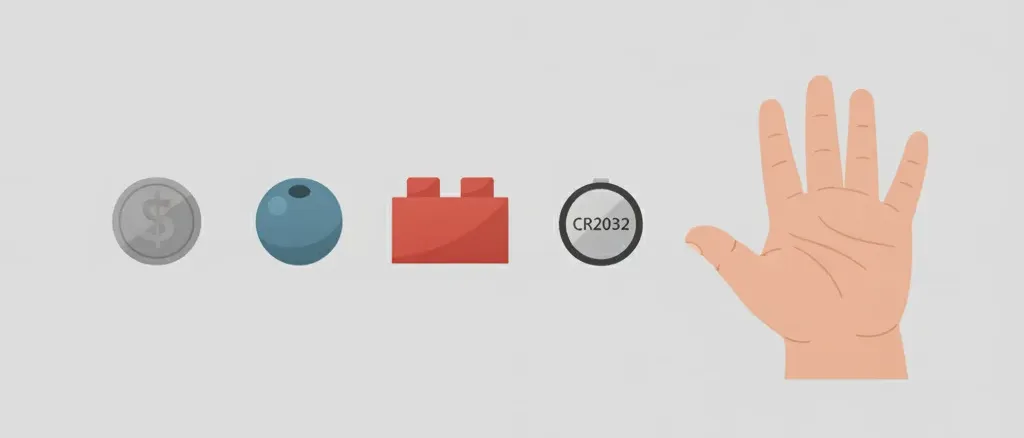
Swallowing things is what toddlers do — everything goes in the mouth between about six months and three years, and parents know it. The fear it produces is lopsided in two directions at once. On the harm axis it is overestimated: a swallowed coin or bead feels like an acute emergency, the kind of thing that warrants a panicked drive to the ER, when in practice the great majority of swallowed objects pass on their own. On the frequency axis it is underestimated: almost no parent guesses that medically-attended ingestions are common enough to put roughly one child in ninety through an emergency department before kindergarten.
Rough estimate: A swallowed object feels like a likely emergency; most parents would also under-guess how routinely it lands a child in the ER
Source: editorial intuition, not polled
Actual
~43,000 US ED visits/year for swallowed objects in children under 6 (≈118/day, 2015)
US children under 6, ED-treated foreign-body ingestion (NEISS, all object types)
Show derivation
Likelier normally reports lifetime-US-adult probabilities; this entry is scoped to the peak-risk early-childhood window (under 6) for a single US child, the same way the button-battery and toddler-choking entries are. Orsagh-Yentis et al. (Pediatrics 2019), analysing the CPSC's National Electronic Injury Surveillance System, estimated about 759,000 US children under six treated in emergency departments for swallowed objects across 1995-2015, rising to roughly 43,000 in 2015 — a rate of about 18 per 10,000 under-six children per year. Compounded across the six-year window, 1 - (1 - 1.8e-3)^6 ≈ 0.011, or roughly 1 in 90 per child. This counts medically-attended ingestions only: the true number of objects that are swallowed and pass unnoticed at home is necessarily higher and unmeasurable, while fatal or surgical outcomes are far rarer (see regional_breakdown). The figure spans all object types; the dangerous-object subsets (button batteries, multiple magnets, sharp objects) carry their own entries and their own much lower but higher-severity rates.
Caveats: The 1-in-90 headline is the medically-attended rate — children taken to an emerg…
The 1-in-90 headline is the medically-attended rate — children taken to an emergency department for a swallowed object — not the chance of ever swallowing anything. Most objects a toddler mouths either never go down or pass unnoticed, and those events are unmeasurable. The often-quoted figure of ~1,500 foreign-body deaths per year in the United States (AAFP) is all-ages and dominated by airway obstruction (choking and asphyxiation), not toddlers passing swallowed objects through the gut; pediatric deaths from ingested (as opposed to inhaled) objects are rare and concentrated in the button-battery, multiple-magnet, and sharp-object subsets, each of which has its own entry. The 80-90% / 10-20% / ~1% spontaneous-passage / endoscopy / surgery split is a single canonical clinical figure restated across the review literature, not three independent measurements. The "it will pass" reassurance applies to blunt objects that have already reached the stomach, such as a swallowed coin, bead, or smooth pebble; sharp or pointed objects perforate in 15-35% of cases, and any object lodged in the esophagus rather than the stomach needs prompt removal regardless of what it is.
How the risk varies
The headline figure averages across very different situations. Here’s how the probability varies by scenario or context:
1 in 91 · 1.1%
~18 ED visits per 10,000 under-six children per year (Orsagh-Yentis, 2015), compounded across the six-year window. This is the medically-attended rate, not the chance of ever swallowing anything — most mouthed objects pass unnoticed and are never counted.
1 in 10 · 10%
Just over 10% of children evaluated for a swallowed object were admitted (Orsagh-Yentis). Most of the rest were observed, X-rayed, and discharged.
1 in 6.7 · 15%
10-20% of ingested foreign bodies are retrieved endoscopically (AAFP, Lee), typically because the object lodged in the esophagus or is high-risk (battery, sharp). The midpoint ~15% is used here.
1 in 100 · 1.0%
About 1% of ingested foreign bodies require open surgery (AAFP, Lee) — perforation, obstruction, or magnet/battery injury. The overwhelming majority never reach this stage.
Bar length and shade rank these scenarios against each other, not against other risks. The exact odds are shown beside each.
Related risks
Other risks on similar themes — for exploring related fears.

Toddler stair fall
What are the odds of a toddler suffering serious injury from falling down stairs?



Maternal age & birth defects
What are the odds of a baby having a chromosomal disorder based on parental age?


C-section complications
What are the odds of serious complications from a C-section vs vaginal birth?


Play swing & slide injury
What are the odds of a child being injured by common play activities like arm-swinging or going down a slide together?
Pick challenger
Swallowing things is what toddlers do. Everything goes in the mouth between about six months and three years, because that is how a small child maps the world. Most of what gets mouthed comes straight back out, a fraction goes down, and a smaller fraction of that ends up in an emergency department. US surveillance data put that last number higher than most parents would guess: an estimated 759,000 children under six were treated for swallowed objects across 1995-2015, and the annual count nearly doubled to roughly 43,000 by 2015 — about one child every twelve minutes. Compounded across the six years before kindergarten, that is on the order of one child in ninety. Coins are the object in 62% of cases, far ahead of toys, jewelry, and batteries. The rest is a long tail of small, inedible, non-food objects within a crawling child’s reach: beads and marbles, small toy parts, button batteries, and the pebbles, small stones, and rocks picked up off the ground or a garden path. Almost none of it was ever food; that is the whole category.
The gap between the fear and the outcome is wide. Once an object clears the throat and reaches the stomach, 80 to 90% pass on their own within days; roughly 10 to 20% are retrieved with endoscopy, and about 1% need surgery. Half of children with a confirmed ingestion have no symptoms at all. The usual emergency-department visit is an X-ray and a period of watching, and just over one in ten ends in admission. A blunt object sitting in the stomach is, in the great majority of cases, a waiting problem rather than a cutting one.
What makes the topic genuinely dangerous is a short list of objects that break the “it will pass” rule. A button or coin-cell battery can burn through the esophagus in about two hours. Two or more high-powered magnets, swallowed separately, pinch the bowel wall between them and cause perforation. Sharp or pointed objects perforate in 15 to 35% of cases, and anything lodged in the esophagus rather than the stomach needs prompt removal regardless of what it is. These are the cases where the clock matters, and they are why a swallowed-object call is never waved off over the phone. The figure of roughly 1,500 foreign-body deaths a year in the United States is all-ages and dominated by airway choking, not toddlers passing coins; deaths from swallowed objects in children are rare and sit almost entirely in those battery, magnet, and sharp-object subsets.
Age is the strongest dial. The risk tracks the overlap of three things: the pincer grasp that lets a child pick up a coin, the mobility to reach one, and the absence of any sense that a coin is not food. That window opens around six months, peaks at one to two years, and narrows through the preschool years as children stop reflexively putting objects in their mouths. Below six months the rate is low because the motor skills are not there yet. The exception at the older end is children with developmental delay, autism, or pica, in whom the oral-exploration phase is prolonged; they account for a disproportionate share of repeat and multiple-object ingestions, and they tend to present late, which is what turns an ordinary swallowed object into a surgical one.
Related tidbits
About 1 in 90 US kids gets an ER visit for a swallowed object before age 6 — usually a coin, and 80-90% pass on their own. The exceptions that break the "it'll pass" rule: button batteries, which burn within hours, and multiple magnets, which pinch the bowel.
Claim ledger
Every number below is what each source reported, with the verbatim quote we relied on and how we arrived at our figure. Click any link to verify directly.
6/6 sources independently verified verbatim against the cited source
-
[1] Nationwide Children's Hospital — reporting Orsagh-Yentis, McAdams, Roberts & McKenzie, Pediatrics — Foreign Body Ingestions on the Rise (Orsagh-Yentis et al., Pediatrics 2019;143(5):e20181988) Verified
Foreign Body Ingestions on the Rise (Orsagh-Yentis et al., Pediatrics 2019;143(5):e20181988)- Statistic
~759,000 US children under 6 treated in EDs for foreign-body ingestion, 1995-2015; rate up 91.5% from 9.5 to 18 per 10,000 children; ~43,000 (118/day) in 2015; coins 62%, toys 10%, jewelry 7%, batteries 7%; 62% aged 1-3; just over 10% admitted- Excerpt
“"more than 759,000 children younger than six years were estimated to have been evaluated for foreign body ingestions in emergency departments over the 21-year study period [...] The rate of foreign body ingestions per 10,000 children increased by 91.5%, from 9.5 in 1995 to 18 in 2015. [...] Coins were the most frequent type of objects ingested (62%), followed by toys (10%), jewelry (7%), and batteries (7%). [...] Foreign body ingestions most frequently involved children between one to three years of age (62%). [...] Just over 10% of children were admitted to the hospital as a result of their ingestion." ”
- Source data from
- 2019-04-12
- Accessed
- 2026-06-21 · archived copy
- Verification
- Excerpt independently re-fetched and confirmed word-for-word against the cited source during our grounding audit.
- Calculation
- Primary anchor for the incidence headline, age distribution, object mix, and admission rate. 43,000 ED visits in 2015 against a US under-6 population of about 24 million is ~18 per 10,000 per year, matching the reported 2015 rate. Compounded over the six-year window gives ~1 in 90 per child. Coins at 62% are the dominant object, far ahead of batteries at 7% — the small subset that drives nearly all severe outcomes. The 10% admission rate feeds the regional_breakdown funnel.
- Independence
- Orsagh-Yentis is NEISS population surveillance (CPSC product-injury sampling), a genuinely separate pipeline from the clinical-review figures (AAFP, Lee) on spontaneous passage and from the clinical cohort (Destro) on neurodevelopmental risk. This press release reports the peer-reviewed Pediatrics paper; the journal page itself (publications.aap.org) is paywalled/403 to automated fetching.
-
[2] American Family Physician (AAFP) — Foreign Body Ingestion in Children Verified
Foreign Body Ingestion in Children- Statistic
93-99% of blunt objects pass without intervention; ~1% require surgical removal; 10-20% managed with endoscopy; serious morbidity in <1%; 50% of confirmed ingestions asymptomatic; peaks ages 6 months-3 years; ~1,500 all-ages US foreign-body deaths/year- Excerpt
“"In the pre-endoscopy era, 93 to 99 percent of blunt objects passed without intervention, and approximately one percent required surgical removal. [...] Today, 10 to 20 percent of children who ingest foreign bodies are managed with endoscopy. [...] It causes serious morbidity in less than one percent of all patients, and approximately 1,500 deaths per year are attributed to ingestion of foreign bodies in the United States. [...] A retrospective review found that 50 percent of children with confirmed foreign body ingestions were asymptomatic. [...] Foreign body ingestion is a potentially serious problem that peaks in children aged six months to three years." ”
- Source data from
- 2005-07-15
- Accessed
- 2026-06-21 · archived copy
- Verification
- Excerpt independently re-fetched and confirmed word-for-word against the cited source during our grounding audit.
- Calculation
- Source for the outcome funnel: most blunt objects pass without intervention, ~10-20% need endoscopy, ~1% need surgery, serious morbidity <1%, and half of confirmed ingestions are asymptomatic. The "~1,500 deaths/year" figure is deliberately NOT used in the headline: it is all-ages and dominated by airway obstruction (choking), not toddlers passing swallowed objects through the gut — see caveats.
- Independence
- The 80-90% spontaneous-passage / 10-20% endoscopy / ~1% surgery split is a single canonical clinical figure restated across the review literature. This AAFP review and Lee 2018 (below) are two restatements of the same figure, not independent measurements; treat them as one source for the funnel. The independent pipelines in this entry are Orsagh-Yentis (NEISS surveillance) and Destro (clinical cohort).
-
[3] Clinical Endoscopy 2018;51(2):129-136 — Lee JH — Foreign Body Ingestion in Children Verified
Foreign Body Ingestion in Children- Statistic
80-90% of GI-tract foreign bodies pass spontaneously without complications; 10-20% removed endoscopically; ~1% require open surgery; most events at 6 months-3 years; coins most common; sharp/pointed objects perforate in 15-35%- Excerpt
“"80%-90% of FBs in the gastrointestinal (GI) tract are passed spontaneously without complications, 10%-20% are removed endoscopically, and 1% require open surgery. [...] most events occur in children between 6 months and 3 years of age. [...] Coins are the most commonly ingested FB in children. [...] sharp or pointed FBs can cause perforation in 15%-35% of patients." ”
- Source data from
- 2018-03-30
- Accessed
- 2026-06-21 · archived copy
- Verification
- Excerpt independently re-fetched and confirmed word-for-word against the cited source during our grounding audit.
- Calculation
- Confirms the spontaneous-passage / endoscopy / surgery split and supplies the sharp-object perforation rate (15-35%) used in the caveats and the dangerous-tail framing. Also corroborates the 6-months-to-3-years peak age and coins as the most common object.
- Independence
- Restates the same canonical spontaneous-passage / endoscopy / surgery split as the AAFP review above; the two are one figure restated, not independent confirmation. The sharp-object perforation rate is its distinct contribution.
-
[4] Children (Basel) 2021;8(11):956 — Destro et al. — Foreign Body Ingestion in Neurologically Impaired Children: A Challenging Diagnosis and Management in Pediatric Surgery Verified
Foreign Body Ingestion in Neurologically Impaired Children: A Challenging Diagnosis and Management in Pediatric Surgery- Statistic
Children with intellectual disability/neurodevelopmental delay (ID-ND) commonly ingest foreign bodies; higher risk tied to poor hand-to-mouth control, prolonged oral phase, dysphagia; long delays to presentation drive higher surgery, perforation, and mortality- Excerpt
“"Children with intellectual disability/neurodevelopmental delay (ID-ND) commonly ingest foreign bodies (FB) [...] the higher risk of FB ingestion in ID-ND is related to several reasons, including poor control of hand-to-mouth activity and exploration of objects, prolonged oral phase, dysphagia with limited control over objects placed in the oral cavity, communication impairment, and altered protective mechanisms. [...] Long delays between ingestion to presentation and intervention might account for higher rates of surgery, perforation, and mortality in the group of patients with ID-ND." ”
- Source data from
- 2021-10-23
- Accessed
- 2026-06-21 · archived copy
- Verification
- Excerpt independently re-fetched and confirmed word-for-word against the cited source during our grounding audit.
- Calculation
- Basis for the developmental-delay/autism/pica personal factor. The paper documents that ID-ND children both ingest objects more (prolonged oral-exploration phase) and fare worse (delayed presentation → more surgery, perforation, death). The multiplier is therefore explicitly mixed — incidence, recurrence, and severity — not a clean incidence ratio.
- Independence
- A clinical cohort/case series, methodologically distinct from the NEISS population surveillance (Orsagh-Yentis) and from the general clinical-review funnel figures (AAFP, Lee). It addresses a different question (who is at elevated risk and why), so it complements rather than overlaps the other three.
-
[5] National Capital Poison Center — National Capital Poison Center's Button Battery Ingestion Triage and Treatment Guideline Verified
National Capital Poison Center's Button Battery Ingestion Triage and Treatment Guideline- Statistic
Batteries lodged in the esophagus may cause serious burns in as little as 2 hours; immediate removal is required- Excerpt
“"Batteries lodged in the esophagus may cause serious burns in as little as 2 hours... Immediately remove batteries lodged in the esophagus. Serious burns can occur in 2 hours." ”
- Source data from
- 2024-01-01
- Accessed
- 2026-07-03 · archived copy
- Verification
- Excerpt independently re-fetched and confirmed word-for-word against the cited source during our grounding audit.
- Calculation
- Supports the body-prose claim that a button or coin-cell battery lodged in the esophagus can cause severe burns within about two hours — the reason battery ingestion is treated as a same-day emergency rather than folded into the "it will pass" reassurance that applies to blunt objects in the stomach.
- Independence
- National Capital Poison Center clinical guideline, methodologically distinct from the NEISS surveillance (Orsagh-Yentis), the AAFP/Lee clinical-review funnel figures, and the Destro ID-ND cohort above.
-
[6] Frontiers in Pediatrics 2021;9:727988 — Altokhais T — Magnet Ingestion in Children: Management Guidelines and Prevention Verified
Magnet Ingestion in Children: Management Guidelines and Prevention- Statistic
Two or more ingested high-powered magnets can attract across the gastrointestinal wall, causing ischemia, tissue necrosis, perforation, fistula formation, obstruction, peritonitis, or death; NEISS estimated 16,386 possible magnet ingestions among US children under 18 from 2002-2011- Excerpt
“"Magnet pieces attract each other across the walls of the gastrointestinal tract, causing ischemia, tissue necrosis, perforation, fistula formation, obstruction, peritonitis, or death." ”
- Source data from
- 2021-08-04
- Accessed
- 2026-07-03 · archived copy
- Verification
- Excerpt independently re-fetched and confirmed word-for-word against the cited source during our grounding audit.
- Calculation
- Supports the body-prose claim that two or more high-powered magnets, swallowed separately, pinch bowel tissue between them and cause perforation — the mechanism that makes multiple-magnet ingestion a distinct surgical emergency rather than an "it will pass" case, alongside button batteries and sharp objects.
- Independence
- Peer-reviewed clinical review, methodologically distinct from the NEISS surveillance (Orsagh-Yentis), the AAFP/Lee clinical-review funnel figures, the Destro ID-ND cohort, and the National Capital Poison Center battery guideline above.