Evidence quality 4.75/5
Eight-dimension review score against the quality rubric . Each dimension scored 1–5.
- D1 Source grounding
- 5/5
- D2 Source authority
- 5/5
- D3 Arithmetic
- 5/5
- D4 Uncertainty
- 4/5
- D5 Scope
- 5/5
- D6 Prose
- 5/5
- D7 Perception honesty
- 4/5
- D8 Caveat completeness
- 5/5
≈ As likely as
Perceived
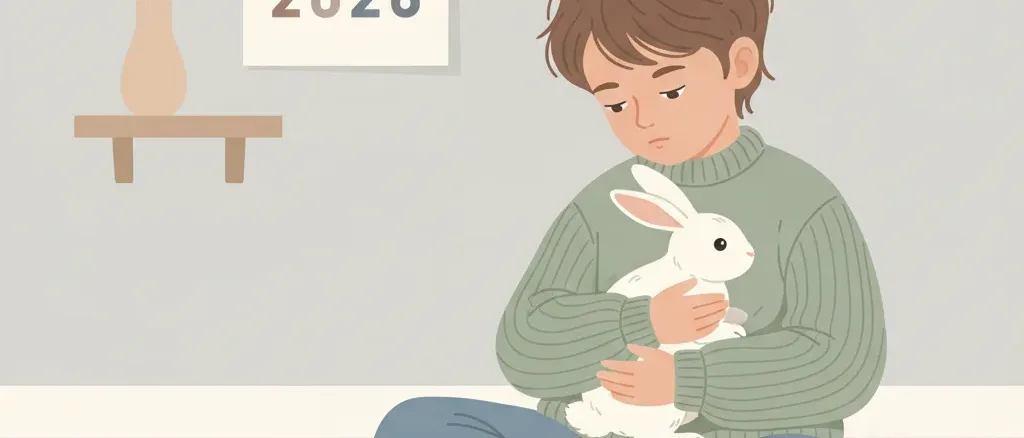
Parents and children often assume rabbits are short-lived "starter pets" in the same league as hamsters — something that will likely be gone within a year or two. In practice, a well-cared-for indoor domestic rabbit typically lives 8–12 years, making a rabbit given to a 9-year-old quite likely to still be alive when that child turns 13. No rigorous survey has directly measured parental intuitions about rabbit lifespan in the context of childhood pet ownership, so this entry is marked intuition-kind.
Rough estimate: many parents assume rabbits live 2-4 years, similar to hamsters
Source: editorial intuition, not polled
Actual
~30 of 100 indoor pet rabbits die within 4 years of acquisition
Indoor domestic pet rabbits in family households
Show derivation
A retrospective Japanese study of 898 pet rabbits seen at an exotic animal clinic (2006–2020) found a median lifespan of 7 years (IQR 5–9), with 18% surviving beyond 9 years. Applying an exponential survival model with λ = ln(2)/7 ≈ 0.099 per year, the probability of dying within 4 years from acquisition (at ~8–12 weeks old) is 1 − e^(−0.099 × 4) ≈ 0.33. The House Rabbit Society reports indoor house rabbits typically live 8–12 years under optimal conditions; using a median of 10 years gives λ ≈ 0.069 and P(4 years) ≈ 0.24. A central estimate of 0.30 splits between typical and optimal care, reflecting that a child's first rabbit often receives adequate but not always expert husbandry. Scope is subgroup_lifetime: the figure applies to a 4-year window after pet acquisition, not to a 59-year adult lifetime.
Caveats: Scope is subgroup_lifetime — this is a 4-year window probability, not a 59-year …
Scope is subgroup_lifetime — this is a 4-year window probability, not a 59-year adult lifetime figure. Results vary significantly by breed (small breeds such as Netherland Dwarf live longer than large breeds like Flemish Giants), indoor vs. outdoor housing (outdoor rabbits have median lifespans roughly half as long), spay/neuter status (unspaying carries a high lifetime uterine-cancer risk in females, and the House Rabbit Society reports 8–12 year life expectancy for spayed/neutered indoor rabbits), age at acquisition (older rabbits have fewer years remaining), and access to veterinary care. A rabbit acquired at age 2 rather than 8 weeks would face a materially lower 4-year mortality risk. The 30% central estimate reflects a typical indoor pet rabbit with average-quality child-household care.
Related risks
Other risks on similar themes — for exploring related fears.
Indoor cat escape harm
What are the odds of a strictly indoor cat suffering serious injury or death after escaping outdoors?

Hamster dies before teenager
What are the odds a hamster given to a 9-year-old dies before they turn 13?



Grandparent loss in childhood
What are the odds a 9-year-old loses at least one grandparent before turning 18?

Kids & explicit content
What are the odds of a child encountering explicit or violent content online before age 13?


Decisions this risk informs
Choices that turn on this risk — how people weigh the trade-off.
Pick challenger
Domestic rabbits live far longer than most people expect. A well-cared-for indoor pet rabbit has a median lifespan of roughly 7–10 years depending on breed, care quality, and whether it has been spayed or neutered. A child who receives a rabbit at age 9 is likely to still have that animal when they turn 13 — the four-year window that matters here only captures the early portion of a rabbit’s expected life. Applying an exponential survival model to the median lifespan reported in peer-reviewed retrospective data suggests roughly 25–33% of typical pet rabbits die within four years of acquisition. The central estimate of 30% reflects average child-household care, which is adequate but rarely as thorough as the husbandry practiced by dedicated rabbit owners.
The contrast with hamsters is stark and often overlooked. A Syrian hamster — the most common species sold in pet stores — has an average lifespan of two to three years. A hamster acquired at age 9 is nearly certain to be gone before the child turns 12, let alone 13. Rabbits are routinely grouped with hamsters and guinea pigs in the cultural category of “small, easy, short-lived pets,” but that framing is wrong for rabbits. A rabbit is more comparable in longevity to a cat than to a hamster: both can live into their early teens with good care, and both require a decade-long commitment rather than a 1–3 year one.
Several variables shift the probability meaningfully. Outdoor rabbits face predators, extremes of temperature, and diseases that cut life expectancy substantially compared to indoor counterparts. Unspayed female rabbits carry a high lifetime risk of developing uterine cancer, which makes spaying a major longevity intervention, not merely an optional procedure — the House Rabbit Society notes that a spayed or neutered house rabbit has a life expectancy of 8 to 12 years. Small breeds such as Netherland Dwarfs and Mini Lops typically outlive large breeds like Flemish Giants by several years. A rabbit acquired at eight weeks old faces a different 4-year survival curve than one acquired as a two-year-old adult from a rescue. These factors compound: the best-case scenario (indoor, neutered, small breed, rabbit-specialist vet) produces a 4-year mortality risk closer to 18–20%; the worst realistic scenario (outdoor, unspayed female, minimal veterinary care) climbs toward the top of this entry’s uncertainty range, around 45%.
Related tidbits
About 3 in 10 indoor pet rabbits die within 4 years of a child acquiring one. The death of a first pet is common enough that families often face the question of how to explain it.
In a Swedish bereavement cohort, 27% of parents who avoided talking honestly about death later regretted not having done so. None of the 147 parents who did talk regretted it.
Claim ledger
Every number below is what each source reported, with the verbatim quote we relied on and how we arrived at our figure. Click any link to verify directly.
1/3 sources independently verified verbatim against the cited source
-
[1] Journal of Exotic Pet Medicine (ScienceDirect) — Age at death and cause of death of pet rabbits (Oryctolagus cuniculus) seen at an exotic animal clinic in Tokyo, Japan: a retrospective study of 898 cases (2006–2020)
Age at death and cause of death of pet rabbits (Oryctolagus cuniculus) seen at an exotic animal clinic in Tokyo, Japan: a retrospective study of 898 cases (2006–2020)- Statistic
Median age at death of 898 pet rabbits was 7 years (IQR 5–9); 18% lived beyond 9 years- Excerpt
“"The median age at death was 7 years (interquartile range: 5 to 9 years), and 18% of all rabbits lived beyond 9 years. The main causes of death included neoplasia (n = 223; 24.8%), gastrointestinal disease (n = 135; 15.0%), bacterial abscess (n = 90; 10.0%), urinary disease (n = 85; 9.5%), trauma (n = 44; 4.9%), and cardiac disease (n = 27; 3.0%)." ”
- Source data from
- 2022-07-01
- Accessed
- 2026-05-03 · archived copy
- Calculation
- Median lifespan of 7 years from this peer-reviewed retrospective is the primary anchor for the central estimate. Applying an exponential survival model: λ = ln(2) / 7 ≈ 0.099 per year. P(rabbit dies within 4 years of acquisition) = 1 − e^(−0.099 × 4) = 1 − 0.671 ≈ 0.33. This population (clinic patients in an exotic-animal practice in Tokyo) likely overrepresents rabbits receiving better-than-average care, so 0.33 may be a slight underestimate relative to the average child's pet rabbit. Used as the lower anchor of the central estimate.
- Independence
- Drawn from a Japanese exotic-animal clinic's case records (2006–2020); methodologically independent of the UK VetCompass cohort and the House Rabbit Society lifespan guidance.
-
[2] House Rabbit Society — How Long Do Rabbits Live? Verified
How Long Do Rabbits Live?- Statistic
Indoor house rabbits typically live 8–12 years- Excerpt
“"Indoor house rabbits typically live 8–12 years, depending on their size, breed, and the quality of care they receive. A well-cared-for house rabbit that has been spayed or neutered early in life has a life expectancy of 8 to 12 years." ”
- Source data from
- 2024-01-01
- Accessed
- 2026-05-03 · archived copy
- Verification
- Excerpt independently re-fetched and confirmed word-for-word against the cited source during our grounding audit.
- Calculation
- Under ideal indoor care (spayed/neutered, optimal diet), median lifespan is approximately 10 years. Applying exponential survival: λ = ln(2)/10 ≈ 0.069 per year. P(dies within 4 years) = 1 − e^(−0.069 × 4) ≈ 0.24. This represents the lower bound of the uncertainty range — best-case indoor care. The 12-year upper end of HRS's range gives λ = 0.058, P(4 years) ≈ 0.21. The 8-year lower end gives λ = 0.087, P(4 years) ≈ 0.30, consistent with the central estimate. Difference between HRS guidance and clinical studies likely reflects selection bias in both directions: HRS population are committed rabbit owners; clinic patients skew toward unwell rabbits.
- Independence
- House Rabbit Society is the leading US rabbit welfare organization, drawing on veterinary guidance and member surveys. Methodologically independent of the Japanese and UK academic studies.
-
[3] Veterinary Record / O'Neill et al. (VetCompass Programme) — Morbidity and mortality of domestic rabbits (Oryctolagus cuniculus) under primary veterinary care in England
Morbidity and mortality of domestic rabbits (Oryctolagus cuniculus) under primary veterinary care in England- Statistic
Median age at death among 370 rabbits that died during the study was 4.3 years (IQR 2.1–7.0, range 0.1–14.4)- Excerpt
“"The median age at death of the 370 rabbits that died during the study was 4.3 years (IQR 2.1–7.0, range 0.1–14.4). For males, the median age at death was older (5.2 years, IQR 3.0–8.1, range 0.2–14.4) than for females (3.7 years, IQR 2.0–5.9, range 0.1–11.8)." ”
- Source data from
- 2020-01-01
- Accessed
- 2026-05-03 · archived copy
- Calculation
- The VetCompass UK figure of 4.3 years is the median age at death among rabbits that died during a 1-year observational window (2013) across 107 clinics — it is NOT a cohort survival median. It captures which rabbits were dying at the time of observation, which skews toward younger ages because older rabbits had not yet died. This number should not be read as "median lifespan = 4.3 years." The Japanese retrospective (7-year median) is a more direct measure of lifespan because it follows rabbits through to death. The UK study is included as independent corroboration of mortality patterns and cause-of-death data (flystrike, GI stasis, anorexia) rather than as a lifespan anchor. The UK study also includes outdoor rabbits, who have significantly shorter lifespans than indoor pets.
- Independence
- VetCompass draws from primary-care veterinary records across England in 2013; methodologically independent of both the Japanese clinic study and the HRS member-survey data.