Evidence quality 4.25/5
Eight-dimension review score against the quality rubric . Each dimension scored 1–5.
- D1 Source grounding
- 4/5
- D2 Source authority
- 5/5
- D3 Arithmetic
- 4/5
- D4 Uncertainty
- 4/5
- D5 Scope
- 4/5
- D6 Prose
- 4/5
- D7 Perception honesty
- 4/5
- D8 Caveat completeness
- 5/5
● your factors — click this risk ▾ to reveal
- Your factors
≈ As likely as
Perceived
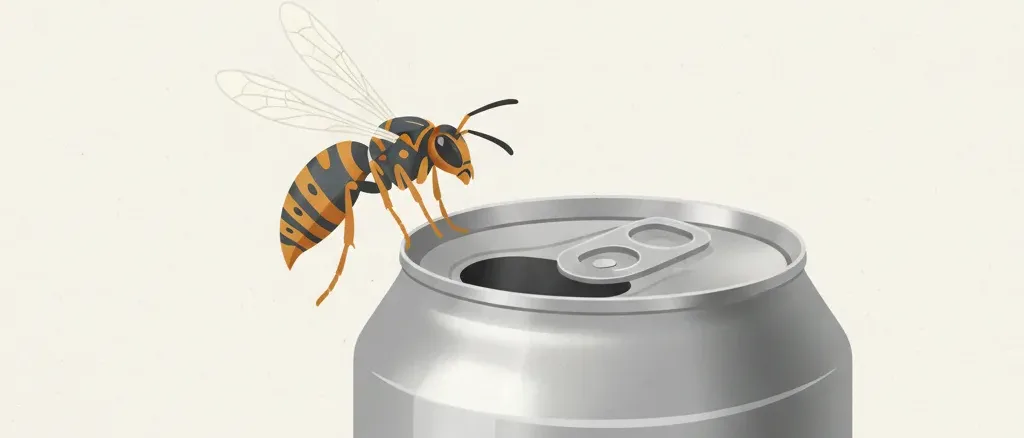
The "bee in the soda can" scenario is one of the more vivid and widely circulated outdoor hazard stories. Social media amplifies occasional case reports of people who swallowed an insect, felt a sting in the throat, and required emergency treatment, which inflates the perceived frequency considerably relative to the actual rate. Most people who have spent summers drinking outdoors overestimate how often this ends badly.
Rough estimate: most outdoor drinkers assume this happens several times a year to someone they vaguely know
Source: editorial intuition, not polled
Actual
~195 estimated oropharyngeal (mouth/throat) sting emergency visits per year, United States
US total population
Show derivation
Huff, Phillips, and Keith (Wilderness & Environmental Medicine, 2025) used NEISS data (2004–2023) and directly estimated that between 2004 and 2023 there were approximately 3890 (95% CI, 2458.55–5320.79) people with oropharyngeal (mouth and throat) stings from bees, hornets, yellow jackets, or wasps who presented to US emergency departments — roughly 195 per year over the 20-year window. Annual probability: 195 / 335,000,000 ≈ 5.8 × 10^-7. Compounded over 59 years of remaining adult life: 1 - (1 - 5.8e-7)^59 ≈ 3.4 × 10^-5 ≈ 1 in 29,000. The uncertainty band carries the study's own 95% CI through the same lifetime compounding (2458.55–5320.79 over 20 years → ~123–266/year). "Oropharyngeal sting" is broader than the specific can/bottle-drinking scenario, but the NEISS study is the only US surveillance source that directly quantifies this route.
Caveats: The mechanism here is not mechanical choking — bees and wasps are too small to o…
The mechanism here is not mechanical choking — bees and wasps are too small to obstruct the airway as a physical object. The danger is the sting itself: inside the mouth or throat it causes localized inflammatory edema that can narrow the airway even in non-allergic individuals, and in those with venom allergy it can trigger full systemic anaphylaxis. The ~195/year figure is the 2025 NEISS study's own national estimate of oropharyngeal sting ED presentations (~3,890 over 2004–2023); it is not a direct count of "swallowed insect while drinking" and may include other routes of oral sting (e.g., eating). Deaths from specifically swallowed insects are not separately tracked.
Related risks
Other risks on similar themes — for exploring related fears.


Sting anaphylaxis
What are the odds that a bee or wasp sting will trigger anaphylactic shock requiring an epinephrine injection?




Pick challenger
A bee or wasp inside a can or bottle is a genuine, if rare, hazard — and the mechanism is less obvious than most people assume. The danger is not that the insect physically blocks your airway; bees and wasps are small enough to swallow without obstruction. The danger is the sting: delivered inside the mouth, posterior pharynx, or esophagus, it triggers localized inflammatory edema in confined anatomy where even modest swelling can produce stridor, difficulty swallowing, and in severe cases airway compromise — even in people with no prior venom allergy. In those who do have venom allergy (roughly 3% of US adults), an oropharyngeal sting can trigger full systemic anaphylaxis.
A 2025 NEISS analysis by Huff, Phillips, and Keith directly estimated that between 2004 and 2023 approximately 3,890 people presented to US emergency departments with an oropharyngeal (mouth or throat) sting from a bee, hornet, yellow jacket, or wasp — about 195 per year, roughly 5% of all sting ED visits. Spread over 335 million people and 59 remaining adult years, that comes to roughly 1 in 29,000 over a lifetime. The large majority were minor: about 98% of oropharyngeal sting patients were not admitted to the hospital. Deaths from this specific route are not separately tracked in US surveillance; they are absorbed into the ICD-10 X23 “sting” category that averages ~72 per year from all mechanisms combined.
The fear is real but the framing matters: the scenario to worry about is not “the insect itself gets stuck” but “the sting triggers swelling or anaphylaxis in a place the body finds very hard to manage.” Practical risk reduction is simple — check the opening of outdoor cans and bottles before drinking, pour into a clear glass, or use a cup with a lid. These are low-friction habits that effectively eliminate the exposure route without any change to outdoor behavior otherwise.
Related tidbits
Mouth and throat stings, often from an insect swallowed with food or drink, send an estimated 11,000 people to US emergency departments a year. The lifetime odds work out to about 1 in 500.
Claim ledger
Every number below is what each source reported, with the verbatim quote we relied on and how we arrived at our figure. Click any link to verify directly.
4/4 sources independently verified verbatim against the cited source
-
[1] Wilderness & Environmental Medicine (Huff, Phillips, Keith) — Oropharyngeal Bee, Hornet, Yellow Jacket, and Wasp Stings: A National Electronic Injury Surveillance System Analysis and Scoping Review Verified
Oropharyngeal Bee, Hornet, Yellow Jacket, and Wasp Stings: A National Electronic Injury Surveillance System Analysis and Scoping Review- Statistic
An estimated 3890 (95% CI, 2458.55–5320.79) oropharyngeal sting ED presentations in the US over 2004–2023 (~195/year); oropharyngeal stings were ~5.08% of all stings; 98.08% of oropharyngeal sting victims were not admitted- Excerpt
“"Between 2004 and 2023, there were an estimated 3890 (95% CI, 2458.55–5320.79) people with oropharyngeal stings from bees, hornets, yellow jackets, or wasps in the United States who presented to emergency departments." "Stings to the oropharyngeal region represented an estimated 5.08% (95% CI, 3.59–6.56) of all stings." "Overall, 98.08% (95% CI, 94.25–100.00) of victims of oropharyngeal stings were not admitted to the hospital." ”
- Source data from
- 2025-03-01
- Accessed
- 2026-05-04 · archived copy
- Verification
- Excerpt independently re-fetched and confirmed word-for-word against the cited source during our grounding audit.
- Calculation
- Used for the direct national estimate: ~3890 oropharyngeal sting ED presentations over 2004–2023 = ~195/year. Annual probability 195/335,000,000 ≈ 5.8e-7; compounded over 59 years ≈ 3.4e-5 ≈ 1 in 29,000. The 95% CI (2458.55–5320.79 over 20 years) is carried through the same compounding for the uncertainty band. The ~1.92% hospitalization sub-fraction (98.08% not admitted) is a severity anchor.
- Independence
- Based on NEISS (National Electronic Injury Surveillance System) consumer product injury data, methodologically independent of NCHS death-certificate mortality counts.
-
[2] Frontiers in Veterinary Science (Marinho & Soto-Blanco) — Toxicological Risk Assessment of the Accidental Ingestion of a Honeybee (Apis mellifera L.) Present in Food Verified
Toxicological Risk Assessment of the Accidental Ingestion of a Honeybee (Apis mellifera L.) Present in Food- Statistic
The actual number of accidental honeybee ingestion incidents remains unknown; though a rare condition, ingestion may induce an allergic reaction in sensitive individuals- Excerpt
“A number of anecdotal reports of accidental ingestion of insects are largely available, but the actual number remains unknown. Thus, although it is a rare condition, there is the risk that the ingestion of a honeybee may induce an allergic reaction to some venom components in sensitive individuals. ”
- Source data from
- 2020-10-01
- Accessed
- 2026-05-04 · archived copy
- Verification
- Excerpt independently re-fetched and confirmed word-for-word against the cited source during our grounding audit.
- Calculation
- Supports the surveillance gap: the peer-reviewed toxicological assessment states that the actual number of accidental ingestion incidents remains unknown (reports are anecdotal). Used to justify the wide uncertainty band and to establish that the Huff 2025 oropharyngeal fraction is the best available approximation. Note: this source addresses honeybees only and does not itself quantify deaths or ER visits.
- Independence
- Toxicological review drawing on venom-composition and clinical toxicology literature, independent of NEISS and NCHS data streams.
-
[3] American Family Physician (Golden DB) — Stinging Insect Allergy Verified
Stinging Insect AllergySee all 2 Likelier entries citing this source →
- Statistic
Systemic allergic reactions to insect stings are estimated to occur in about 3% of US adults (and about 1% of children)- Excerpt
“"Systemic allergic reactions to insect stings are estimated to occur in about 1 percent of children and 3 percent of adults." ”
- Source data from
- 2003-06-15
- Accessed
- 2026-07-03 · archived copy
- Verification
- Excerpt independently re-fetched and confirmed word-for-word against the cited source during our grounding audit.
- Calculation
- Supports the body-prose reference to venom-allergy prevalence (~3% of US adults) used as context for anaphylaxis risk from an oropharyngeal sting. Not used in the native/normalized probability calculation, which is based on the Huff 2025 NEISS oropharyngeal-fraction analysis.
- Independence
- Independent clinical epidemiology review (American Family Physician), methodologically distinct from the NEISS-based Huff 2025 analysis and the honeybee-ingestion toxicological review.
-
[4] Centers for Disease Control and Prevention — Morbidity and Mortality Weekly Report — QuickStats: Number of Deaths from Hornet, Wasp, and Bee Stings Among Males and Females — National Vital Statistics System, United States, 2011-2021 Verified
QuickStats: Number of Deaths from Hornet, Wasp, and Bee Stings Among Males and Females — National Vital Statistics System, United States, 2011-2021- Statistic
788 total US deaths from hornet, wasp, and bee stings during 2011-2021, an average of 72 deaths per year; classified under ICD-10 code X23- Excerpt
“"During 2011-2021, a total of 788 deaths from hornet, wasp, and bee stings occurred (an average of 72 deaths per year). [...] Deaths from hornet, wasp, and bee sting as underlying cause of death were coded as X23, according to the International Classification of Diseases, Tenth Revision." ”
- Source data from
- 2023-07-07
- Accessed
- 2026-07-03 · archived copy
- Verification
- Excerpt independently re-fetched and confirmed word-for-word against the cited source during our grounding audit.
- Calculation
- Supports the body-prose reference to overall Hymenoptera sting deaths (~72/year, ICD-10 X23) used as a severity anchor and to explain why deaths from the specific swallowed-insect/oropharyngeal route are not separately tracked in US surveillance. Not used in the native/normalized oropharyngeal-ED-visit calculation.
- Independence
- NCHS death-certificate mortality data (National Vital Statistics System), methodologically independent of the NEISS-based Huff 2025 ED-visit analysis.