Evidence quality 4.75/5
Eight-dimension review score against the quality rubric . Each dimension scored 1–5.
- D1 Source grounding
- 5/5
- D2 Source authority
- 5/5
- D3 Arithmetic
- 5/5
- D4 Uncertainty
- 4/5
- D5 Scope
- 5/5
- D6 Prose
- 5/5
- D7 Perception honesty
- 4/5
- D8 Caveat completeness
- 5/5
● your factors — click this risk ▾ to reveal
- Your factors
≈ As likely as
Perceived
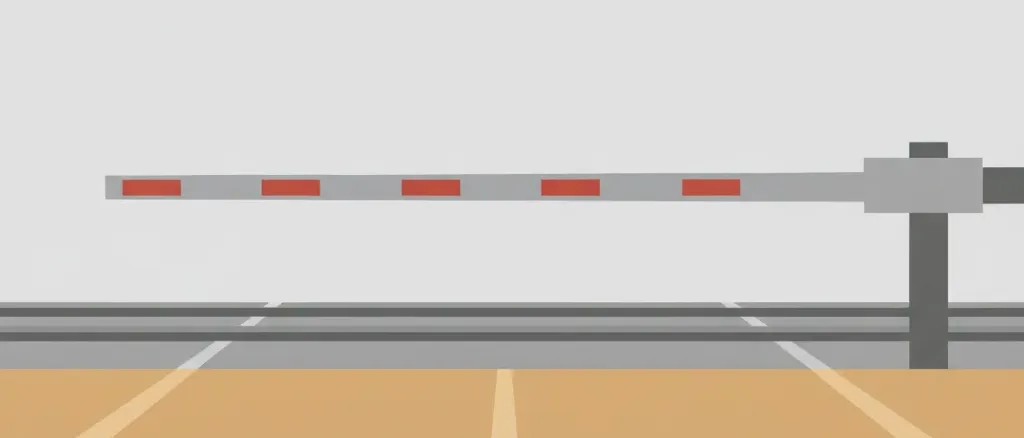
Railroad crossings occupy an odd corner of driver perception: most people have crossed them hundreds of times without incident, which breeds a kind of ambient complacency. The gates come down, the lights flash, and the train passes — a ritual that feels mechanical rather than dangerous. Yet when a crash does happen at a crossing it is violent and almost always fatal, which seeds a residual dread that surfaces whenever someone tells a crossing horror story. The dominant cognitive error is not overestimating the risk but misreading the operational reality: drivers systematically underestimate how many trains use a given crossing per day (the true figure is typically two to ten times higher than intuition suggests) and misjudge train speed and distance, leading some to take gaps that are genuinely too small. The abstract probability, however, is rarely in conscious awareness — most drivers neither fear nor think about crossings as a statistical risk category in the way they might think about highway speed or alcohol.
Source: editorial intuition, not polled
Actual
~1 in 1,210,000 per year
US general population (2022)
Show derivation
276 highway-rail grade crossing fatalities recorded by the Federal Railroad Administration (FRA) and Operation Lifesaver for 2022 (the FRA-revised final figure, up from a provisional 274), divided by the 2022 US population of approximately 335 million, gives an annual rate of 8.24×10⁻⁷ per person. Multiplied over a 59-year adult life horizon (age 18–77): 1 – (1 – 8.24×10⁻⁷)^59 ≈ 4.86×10⁻⁵, or roughly 1 in 20,600. This figure covers all grade-crossing fatalities (vehicle occupants and pedestrians at designated crossing points) but excludes trespass deaths (people struck on open track away from crossings), which add roughly 600–650 additional railroad fatalities per year. The 10-year trend is modestly downward: crossing collision rates are approximately 25% lower than in 2000, though 2024 NSC data show a 7% uptick in crossing fatalities from 2023. The lifetime estimate is treated as a population-average figure; individual risk varies substantially with how many crossings a person uses and whether those crossings have active warning devices (gates and lights) versus passive signage only.
Caveats: The 276-fatality figure covers highway-rail grade crossings only — designated in…
The 276-fatality figure covers highway-rail grade crossings only — designated intersection points where roads cross tracks. It excludes trespass deaths (people struck on open track), which add roughly 600–650 additional railroad fatalities per year and represent a distinct risk category with different behavioral drivers. The population-average lifetime figure (1 in ~20,600) masks large individual variation: someone who commutes daily across an uncontrolled rural crossing faces meaningfully higher risk than someone in a city with no grade crossings on their routes. The 2024 NSC uptick in crossing fatalities (7% over 2023) is notable against a decade-long downward trend and may reflect post-pandemic traffic pattern changes; longer-term trend is still toward lower rates. Pedestrian fatalities at public crossings (87 in 2023 per AAR/FRA data) are included in the headline figure and represent a separate behavioral risk pattern from vehicle occupants.
Related risks
Other risks on similar themes — for exploring related fears.


Child bike trailer
What are the odds of serious injury to a child riding in a towed bicycle trailer?





Driver kills pedestrian
What are the odds that a driver will kill a pedestrian in their lifetime?
Pick challenger
The headline number from FRA and Operation Lifesaver data is approximately 276 fatalities at highway-rail grade crossings per year in the United States (2022 final data), out of roughly 335 million people. That translates to a lifetime probability for a US adult of around 1 in 20,600 — low enough that the average person will never experience it, high enough that it kills someone in the US every day and a third. That works out to roughly four times the lifetime odds of dying in a commercial airline crash, and about 200 times less likely than a fatal motor vehicle crash.
The interesting psychology of this risk is not overestimation or underestimation in the abstract — most drivers rarely think about crossing fatality rates at all. The danger lies in a specific operational miscalibration: a UTRGV study funded by the FRA found that every single one of 18 drivers interviewed underestimated the number of trains using their regular crossings, typically by a factor of two to three and sometimes by a factor of ten. Each safe crossing reinforces the mental model that trains are rare. They are not. The visual cues that reliably indicate train distance and speed for a car — apparent angular size, rate of size change — are systematically misleading for large objects on parallel tracks, leading drivers to take gaps that feel safe but aren’t. This is not recklessness; it is a perceptual failure that persists in people who are paying attention.
The risk picture is bimodal. The majority of crossing fatalities occur at crossings with active warning devices — gates and lights — that were functioning and were ignored or circumvented. Driving around a lowered gate is the single most fatal decision a driver can make at a crossing; crashes of that type are nearly universally fatal for vehicle occupants. For drivers who stop when signals activate, the residual risk is concentrated at passive crossings (crossbuck signs only, common in rural areas) where no automated warning precedes a train’s arrival. The 25% reduction in grade-crossing collision rates since 2000 reflects decades of active warning device upgrades and public education — progress that has plateaued somewhat, with the NSC reporting a 7% uptick in crossing fatalities in 2024.
Related tidbits
A US adult's lifetime odds of dying at a railroad grade crossing are about 1 in 20,700, roughly 1 in 1,220,000 in any given year. Crossing collisions are rare, and most involve a vehicle going around lowered gates rather than a signal failure.
Claim ledger
Every number below is what each source reported, with the verbatim quote we relied on and how we arrived at our figure. Click any link to verify directly.
-
[1] Operation Lifesaver (federally chartered nonprofit using FRA data) — Collisions & Casualties by Year
Collisions & Casualties by Year- Statistic
2,222 highway-grade crossing collisions in 2022; 276 killed; 879 injured- Excerpt
“"All Highway-Rail Incidents at Public and Private Crossings, 2026–1981 ... Year Collisions Fatalities Injuries ... 2022 2,222 276 879" (Source: Federal Railroad Administration) ”
- Source data from
- 2023-01-01
- Accessed
- 2026-06-30 · archived copy
- Calculation
- 276 crossing deaths (FRA-revised final 2022 figure) ÷ 335,000,000 US population = 8.24×10⁻⁷ annual rate per person. Over 59 adult years: 1 – (1 – 8.24×10⁻⁷)^59 ≈ 4.86×10⁻⁵ (≈ 1 in 20,600), within the stated uncertainty band. Operation Lifesaver is a federally chartered nonprofit whose statistics are drawn directly from FRA mandatory accident reporting and are the standard public-facing source for grade-crossing fatality data; the 2022 row was revised upward from 274 to 276 deaths in a subsequent FRA annual revision.
- Independence
- Operation Lifesaver data are derived from FRA mandatory reporting; the NSC and BTS figures below draw on the same FRA database, so these sources share a common upstream data source but are editorially independent in how they present and contextualize the figures.
-
[2] National Safety Council — Injury Facts — Railroad Deaths and Injuries
Railroad Deaths and Injuries- Statistic
Railroad deaths totaled 967 in 2023; 27% at crossings ≈ 261 crossing deaths; highway-rail crossing fatalities increased 7% from 2023 to 2024- Excerpt
“"Railroad deaths totaled 954 in 2024, a 1% decrease from the 2023 revised total of 967. Fatalities at highway-rail crossings increased 7% from 2023 to 2024." ”
- Source data from
- 2025-01-01
- Accessed
- 2026-05-02 · archived copy
- Calculation
- NSC reports crossing fatalities as approximately 27% of total railroad deaths. Applied to the 2023 total of 967 yields ~261 crossing deaths for 2023, consistent with the 2022 OLI figure of 276. The 7% increase in 2024 crossing fatalities is a recent uptick against a longer downward trend. NSC uses FRA data as its primary source.
- Independence
- NSC is editorially independent from Operation Lifesaver and FRA, though all three draw on the same FRA mandatory accident reporting database. NSC's annual Injury Facts compilation adds epidemiological context absent from the raw FRA counts.
-
[3] University of Texas Rio Grande Valley Railway Safety Institute (FRA-funded research) — Drivers' Perceptions of Highway-Rail Grade Crossing Safety and Their Behavior
Drivers' Perceptions of Highway-Rail Grade Crossing Safety and Their Behavior- Statistic
All 18 drivers interviewed underestimated train frequency; actual train crossings are typically 2–3× and sometimes 10× more than drivers expected; 47% of drivers consider crossings a significant hazard above normal driving, 46% do not- Excerpt
“"All 18 drivers interviewed underestimated the frequency of train crossings per day; the actual train crossings are typically two to three times as many as drivers expected and sometimes are 10 times more than expected." ”
- Source data from
- 2017-02-10
- Accessed
- 2026-05-02 · archived copy
- Calculation
- This FRA-funded qualitative and survey study provides the perception data behind the overconfidence framing. The finding that drivers underestimate train frequency by 2–10× is the mechanistic explanation for why crossing violations persist even among drivers who are not impaired or distracted: the rare-train-day heuristic does not update on the base rate.
- Independence
- UTRGV Railway Safety Institute is an FRA-funded academic center; the research is independent of Operation Lifesaver and NSC, providing behavioral and attitudinal data rather than fatality counts.