




Skip to content
Likelier
Financial

Renovating your home vs leaving it as is

Last reviewed 2026-04-26

Evidence quality 4.0/5

Eight-dimension review score against the quality rubric . Each dimension scored 1–5.

D1 Source verification
4/5
D2 Source authority & independence
3/5
D3 Regret-rate accuracy
3/5
D4 Source comparability
3/5
D5 Gilovich pattern
5/5
D6 Prose quality
5/5
D7 Caveat completeness
5/5
D8 Sample quality
4/5
Average 4.0/5
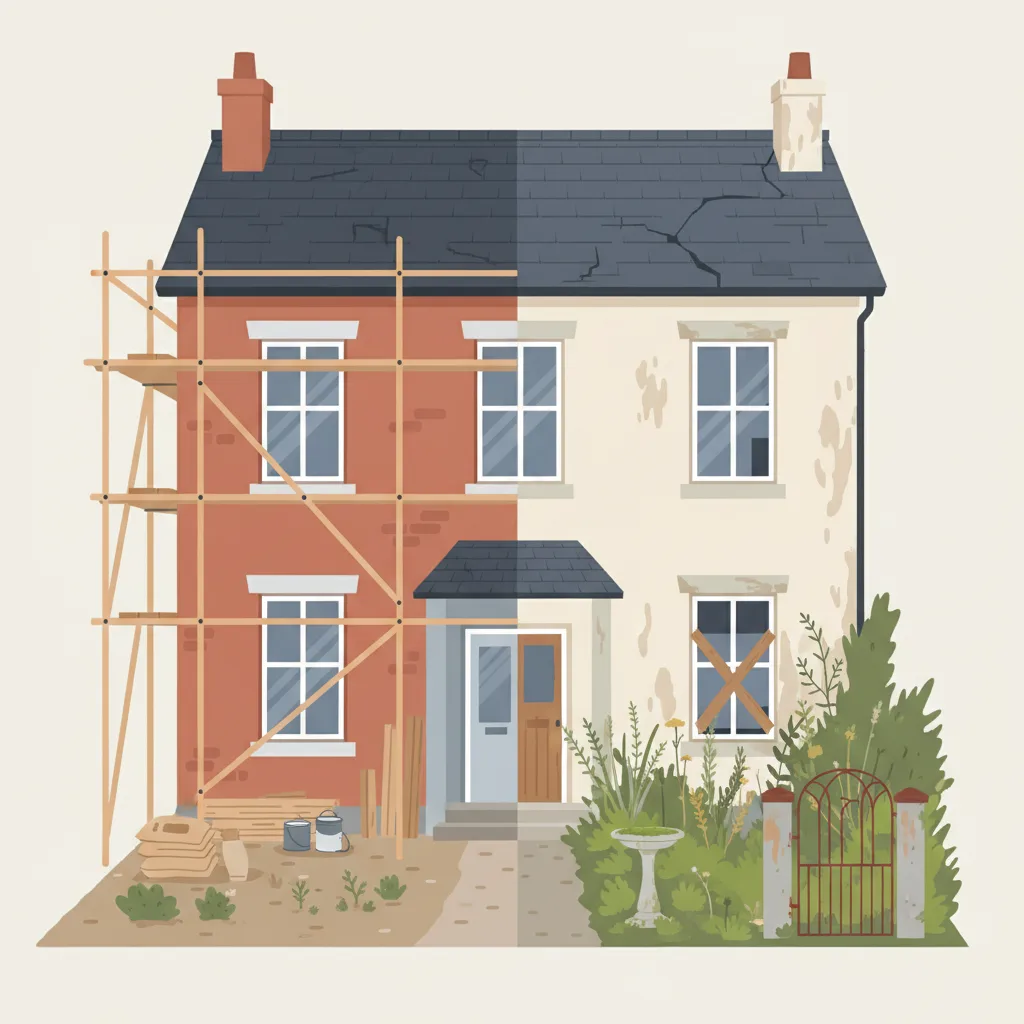
A house split down the middle, one half freshly painted with scaffolding, the other half unchanged and weathered.

Action regret

Renovating

74%

74% of renovators have regrets

US homeowners who renovated in last 5 years

retrospective, within 5 years of renovation

Inaction regret

Leaving as is

32%

32% regret delaying home maintenance and repairs (proxy -- see caveats)

US homeowners, online panel

retrospective, past 12 months

% who regret this choice

action dominates — Action dominates — most regret acting.

Related decisions

Semantically similar decisions — same territory, different trade-offs.

FinancialDirect

Right-size vs. buy bigger

% who regret this choice

Action dominates

Action regret 1.6× higher

Financial

New vs used car

% who regret this choice

Action dominates

Action regret 1.9× higher

FinancialDirect

Buying a house

% who regret this choice

Inaction dominates

Inaction regret 5.6× higher

Financial

Fixed vs. ARM mortgage

% who regret this choice

Action dominates

Action regret 2.5× higher

lifestyle

EV vs gas car

% who regret this choice

Action dominates

Action regret 2.9× higher

Financial

Rent negotiation

% who regret this choice

Inaction dominates

Inaction regret 1.9× higher

lifestyle

Leave hometown

% who regret this choice

Inaction dominates

Inaction regret 1.5× higher

Financial

Crypto vs traditional investing

% who regret this choice

Action dominates

Action regret 2.0× higher

Three out of four homeowners who renovate end up regretting it, according to a 2024 Clever Real Estate survey of 1,000 US homeowners. The regrets span cost overruns (78% exceeded their budget), timeline failures (22% said it took too long), and a remarkable aesthetic backlash: 47% said they preferred their home before the remodel. Nearly two-thirds went into debt to fund the work. A separate Moneywise survey of 1,002 homeowners independently confirmed high renovation distress, with 63% reporting feeling overwhelmed. On the inaction side, Hippo Insurance found that 32% of homeowners regret delaying routine maintenance and necessary repairs — a meaningful minority, but less than half the renovation-regret rate.

The pattern is unusual. Most regret research, following Gilovich and Medvec’s foundational work, finds that inaction regret dominates over time: people eventually stop kicking themselves for what they did and start fixating on what they didn’t do. Home renovation breaks this pattern, almost certainly because the regret is financially concrete. A $15,000 budget overrun that pushed a family into credit-card debt does not soften into a wistful “what if” the way a missed vacation might. The debt persists, the kitchen still has the wrong tile, and the contractor never did come back to fix the grout. Angi’s 2024 State of Home Spending Report adds context: 43% of homeowners say stress from home repairs increased over the past year, and 54% struggle to find qualified professionals — suggesting that even those who want to act face barriers that compound dissatisfaction regardless of which path they choose.

The comparison is imperfect. Clever’s 74% captures anyone with any renovation complaint, from minor (“took too long”) to existential (“ruined my home”); a tighter question would yield a lower rate. Hippo’s 32% measures regret about delaying maintenance, not a deliberate philosophical decision to leave a home unchanged. Still, the directional signal is clear and independently corroborated: in the financial domain, acting rashly generates more regret than sitting tight — a useful corrective to the blanket advice that you should “just do it” with home projects.

Sources: action

Claim ledger

Every number below is what each source reported, with the verbatim quote we relied on and how we arrived at our figure. Click any link to verify directly.

  1. [1] Clever Real Estate — New Data: Home Renovation Trends in 2024
    New Data: Home Renovation Trends in 2024
    Statistic
    74% of homeowners who remodeled have regrets; 47% say they liked their home better before
    Excerpt
    “"74% of homeowners who remodeled have regrets, including 24% who regret spending too much money and 22% who regret the renovation took too long. A whopping 47% go so far as to say that they liked their home more before they remodeled it." ”
    Source data from
    2024-10-01
    Accessed
    2026-04-26
    Calculation
    Clever Real Estate surveyed 1,000 American homeowners who had undergone some level of home renovation within the past five years. Survey conducted August 14-16, 2024. The 74% figure covers all forms of renovation regret (cost, timeline, outcome, aesthetics). Sample size confirmed at 1,000.
  2. [2] Moneywise — Survey: Home Renovation Regrets and Costs
    Survey: Home Renovation Regrets and Costs
    Statistic
    63% of homeowners felt overwhelmed by renovations; 56% felt renovations would never be complete
    Excerpt
    “"About 63% of respondents said their home renovations left them feeling overwhelmed. 56% of respondents felt, at least at some point, that their home renovations will never be complete. The survey of 1,002 homeowners found renovation stress and regret were widespread across project types." ”
    Source data from
    2022-03-15
    Accessed
    2026-04-26
    Calculation
    Moneywise independently surveyed 1,002 US homeowners (March 7-9, 2022). The 63% "overwhelmed" figure provides an independent corroboration of high renovation dissatisfaction separate from the Clever Real Estate study. While not identical to "regret," feeling overwhelmed during a renovation strongly correlates with post-completion regret.

Sources: inaction

Claim ledger

Every number below is what each source reported, with the verbatim quote we relied on and how we arrived at our figure. Click any link to verify directly.

  1. [1] Hippo Insurance / SurveyMonkey — Nearly a Third of Homeowners Regret Delaying Maintenance—and Want To Do Better in 2024
    Nearly a Third of Homeowners Regret Delaying Maintenance—and Want To Do Better in 2024
    Statistic
    32% of homeowners regret delaying routine home maintenance and necessary repairs
    Excerpt
    “"The top regret from the past 12 months was delaying routine home maintenance and/or necessary repairs (32%), followed by neglecting areas that take more effort to maintain (27%) and not DIYing enough home maintenance tasks (21%)." ”
    Source data from
    2024-01-10
    Accessed
    2026-04-26
    Calculation
    SurveyMonkey Audience for Hippo Insurance Services, fielded November 22–24, 2023, with 1,109 completed surveys. The 32% covers homeowners who regretted not acting on maintenance or repairs — the closest available proxy for "leaving the home as is" inaction regret.
  2. [2] Angi — Angi's 2024 State of Home Spending Report
    Angi's 2024 State of Home Spending Report
    Statistic
    43% of homeowners say stress related to home repairs increased over the past year; home projects are the most stressful budget category
    Excerpt
    “"43% of homeowners reported increased stress related to home repairs and maintenance in 2024. Home projects emerged as the single most stressful budget category, ranking ahead of healthcare, debt, savings, childcare, education, and entertainment. 61% are concerned about being able to afford maintenance or repairs in 2025." ”
    Source data from
    2025-01-28
    Accessed
    2026-04-26
    Calculation
    Angi's 2024 State of Home Spending Report provides independent corroboration that deferring home work causes stress. The 43% increased-stress figure is not identical to regret but captures the psychological cost of inaction. Among homeowners who did not renovate, the stress of mounting deferred maintenance aligns with the Hippo 32% regret-about-delay finding.

Caveats

The action and inaction figures come from different surveys with different populations and question framings. The Clever Real Estate 74% captures all forms of renovation dissatisfaction (cost, timeline, aesthetics, outcome) among people who already chose to renovate, which inflates the rate compared to a binary "do you regret doing it?" question. The Moneywise 2022 survey independently confirms high renovation stress (63% overwhelmed) with a separate sample of 1,002 homeowners. The Hippo 32% measures regret about delaying maintenance rather than a deliberate choice to leave a home unchanged, making it an imperfect inaction proxy; Angi's 43% increased-stress figure provides directional support but measures stress, not regret. Generational skew is significant: 89% of Gen Z renovators report regrets versus 51% of boomers, so the population-level 74% masks wide age variance. The action-dominance pattern here contradicts Gilovich and Medvec's typical long-term finding (inaction dominates over time), likely because renovation regret is financially anchored — debt and budget overruns do not fade the way missed-experience regret intensifies. Survey data are drawn exclusively from United States samples; satisfaction and regret rates in countries with different institutional structures — housing markets, contractor regulation, and renovation financing norms — may differ substantially.

Raw data: /api/decisions.json