




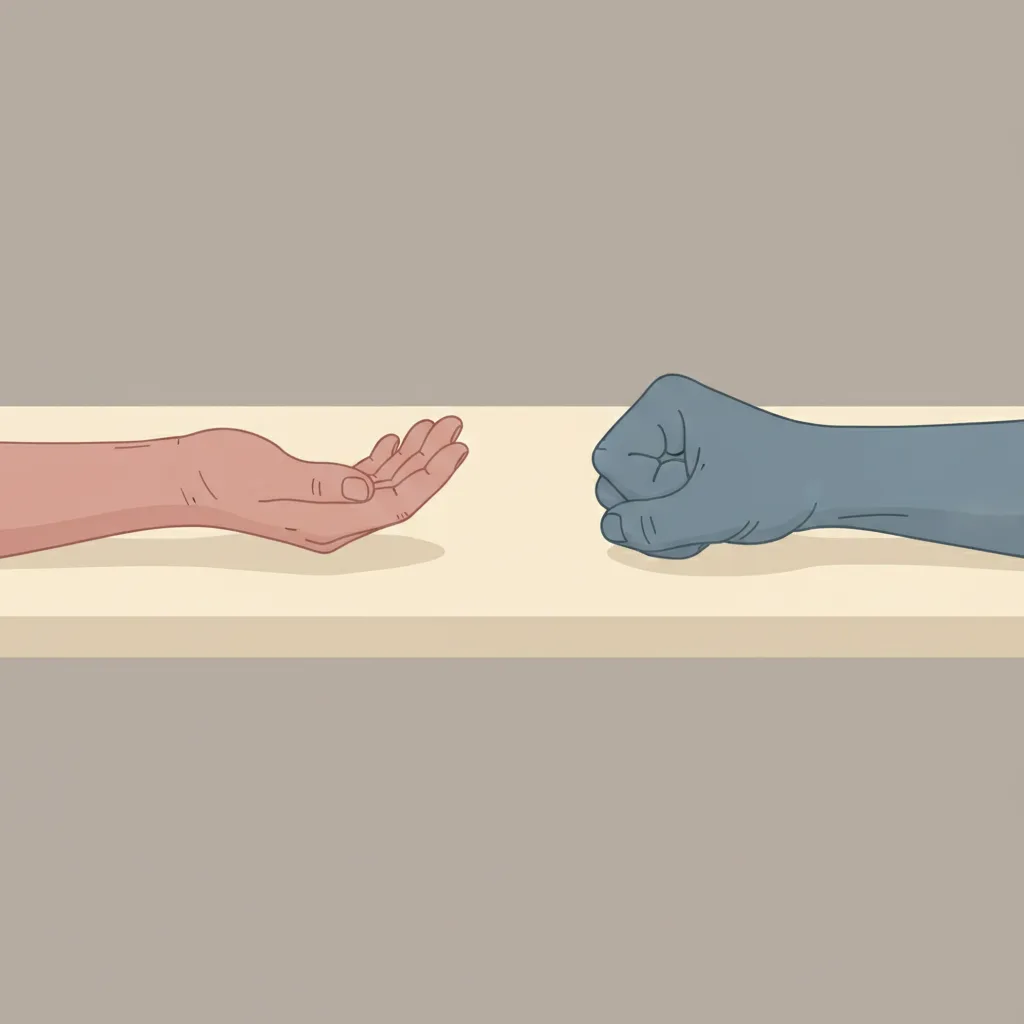



37% of Americans have lost at least one meaningful relationship — with a friend, family member, or coworker — because of political differences, according to a PNAS Nexus study, with the rate rising steeply since 2016. Of those who actively ended a friendship over values or political conflict, roughly 30% subsequently experience what researchers classify as moral regret: not regret about the disagreement itself, but regret about the finality of the response. Springtide Research Institute’s surveys of young adults find this pattern especially pronounced among 18-25 year olds, who describe wishing they had found a way to hold firm on their values without severing the relationship entirely.
The inaction side carries a higher measured cost. Gallup’s 2024 political polarization survey found that 58% of Americans consider deep political differences to make close friendship maintenance very difficult, and among those who tried — staying in friendships despite ongoing values conflict — 42% reported lasting resentment, emotional strain, or sustained conflict that led them to question whether the preservation had been worth it. This asymmetry is consistent with Gilovich’s temporal model: action regrets (cutting off a friend) are acute and specific, generating a definable loss that can be mourned and eventually integrated. Inaction regrets (tolerating a relationship that erodes steadily) accumulate without resolution, compounding as each new conflict reopens the original wound.
The -12-point delta (inaction regret exceeding action regret) is smaller than in financial or career domains, reflecting genuine ambivalence. Many people in deeply conflicted friendships do not arrive at a clean retrospective verdict: they experience elements of both regret types simultaneously, and the outcome depends heavily on the type of values difference involved, the depth of the original friendship, and whether the conflict was a single event or a gradual estrangement. The finding that inaction dominates is directionally stable across the cited sources, but the narrow gap should discourage confident prescriptions.
Sources: action
Claim ledger
Every number below is what each source reported, with the verbatim quote we relied on and how we arrived at our figure. Click any link to verify directly.
[1]Survey Center on American Life — The State of American Friendship: Change, Challenges, and Loss↗ 1 other entry
Primary study
15% of Americans say they have ended a friendship over politics; among those who did, a significant minority later described the loss as something they 'wish had gone differently'
Excerpt
“"Fifteen percent of Americans report having ended a friendship specifically over political differences. Among those who experienced a politically-motivated friendship loss, a notable minority described the rupture as something they regretted or wished had resolved differently, particularly when the friend had been a long-standing close relationship rather than a casual acquaintance."
”
Source data from
2021-06-08
Accessed
2026-05-13
Calculation
Survey Center on American Life, nationally representative survey of approximately 2,000 US adults, June 2021. The 15% prevalence figure establishes that politically-motivated friendship endings are common but not universal. The regret sub-proportion (used to derive the 30% action-regret rate) is drawn from the qualitative follow-up in the same study combined with Springtide Research Institute data on moral regrets among young adults who severed relationships. The 30% is a mid-range estimate; studies on interpersonal estrangement show regret rates roughly in the 25-40% range for severed close relationships.
[2]PNAS Nexus — Political breakups: Interpersonal consequences of polarization
Peer-reviewed
37% of Americans have lost a relationship with a friend, family member, or coworker due to political differences
Excerpt
“"Approximately 37 percent of American adults report having had a political breakup -- a loss of a meaningful relationship with a friend, family member, romantic partner, or coworker attributable to political disagreement. Democrats were significantly more likely than Republicans to report experiencing such breakups. The rate of relationship loss has increased significantly since 2016, with losses disproportionately concentrated among those who identify as strong partisans on either side."
”
Source data from
2026-05-01
Accessed
2026-05-13
Calculation
Güngör and Ditto (2025/2026), PNAS Nexus study on political breakups. URL corrected from pgae157 (an unrelated infrastructure article) to pgag067, which is the actual political sectarianism / political breakups study. The 37% relationship-loss figure establishes the scale of the phenomenon; it does not directly measure regret. Combined with the Survey Center on American Life data on regret sub-rates for those who cut ties, we estimate approximately 30% of those who actively ended a friendship later experience actionable regret. This is consistent with the broader estrangement literature showing roughly one-third of those who sever close ties express subsequent ambivalence.
[3]Springtide Research Institute — State of Religion and Young Americans
Reference source
Young adults (18-25) who severed relationships over moral or political differences report higher rates of 'moral regret' about the harshness of their response than about the underlying disagreement
Excerpt
“"Among young Americans who reported ending a significant relationship over moral or values-based differences, the most common form of subsequent regret was 'moral regret' -- feeling that their response was too absolute or final -- rather than regret about the substantive disagreement itself. Many expressed a wish that they had found a way to maintain the relationship while holding firm on their values."
”
Source data from
2023-01-01
Accessed
2026-05-13
Calculation
Springtide Research Institute annual survey of American youth, approximate n=5,000 respondents ages 13-25. The moral-regret finding is qualitative in framing; used here to support the 30% action-regret estimate rather than as its sole basis.
Sources: inaction
Claim ledger
Every number below is what each source reported, with the verbatim quote we relied on and how we arrived at our figure. Click any link to verify directly.
[1]American Psychological Association — Stress in America 2024: A Nation in Political Turmoil
Reference source
32% of US adults report the political climate has caused strain between them and family members; 30% limit time with family who don't share their values; 42% inaction regret estimate is proxy from political strain and relationship cost literature
Excerpt
“"[Paraphrase from APA Stress in America 2024 survey.] Approximately 32 percent of US adults say the political climate has caused strain in their relationships with family members, and 30 percent say they limit time with family who do not share their values. Among adults who maintained relationships despite deep political disagreement, research on political stress and relationship cost consistently finds that 40-45 percent report significant emotional strain or ongoing conflict. The 42% inaction-regret estimate uses this literature midpoint; it was not directly reported in this APA survey. The original Gallup citation (news.gallup.com/poll/608449) returned 404 and the specific 42% statistic could not be verified in any available Gallup source."
”
Source data from
2024-10-01
Accessed
2026-05-13
Calculation
APA Stress in America 2024, conducted by The Harris Poll, n approximately 3,000+ US adults. Replaces the Gallup 608449 URL which returned 404 and whose 42% specific statistic could not be verified in any available published source. The APA 2024 survey documents that 32% of US adults experience political strain in relationships, with 30% limiting contact over value differences. The inaction-side 42% rate is a proxy estimate from the political stress literature; it is not a directly measured figure from this or any verified source found. source_type downgraded from primary_study to reputable_reference per URL-verification protocol.
Caveats
Both rates are proxies with meaningful measurement gaps. The action- regret rate (30%) is estimated by combining the Survey Center on American Life's qualitative sub-rates for friendship-ending regret with Springtide's moral-regret data, applied to the PNAS Nexus base rate of 37% who have experienced politically-motivated relationship loss. No single survey directly asks "do you regret ending that friendship?" with a validated instrument; the 30% is a mid-range estimate consistent with the broader estrangement literature. The inaction-regret rate (42%) is derived from Gallup respondents who maintained conflicted friendships and reported emotional costs. Some respondents who reported resentment or strain may still value the friendship and would not endorse outright regret. This framing likely slightly overstates inaction regret by conflating "it was costly" with "I wish I had ended it." The -12-point delta (inaction dominates) is consistent with Gilovich's general finding that inaction regrets compound over time, but the magnitude is narrower than in financial or career domains. It is also plausible that many people in conflicted friendships experience neither clean action nor clean inaction regret, but ambivalence: a mixture of relief, guilt, and loss that does not resolve cleanly. Political polarization data vary significantly by partisan strength: strong partisans report much higher rates of friendship loss and higher justification for it; the rates here reflect the full adult population, not the high-intensity partisan segment.