




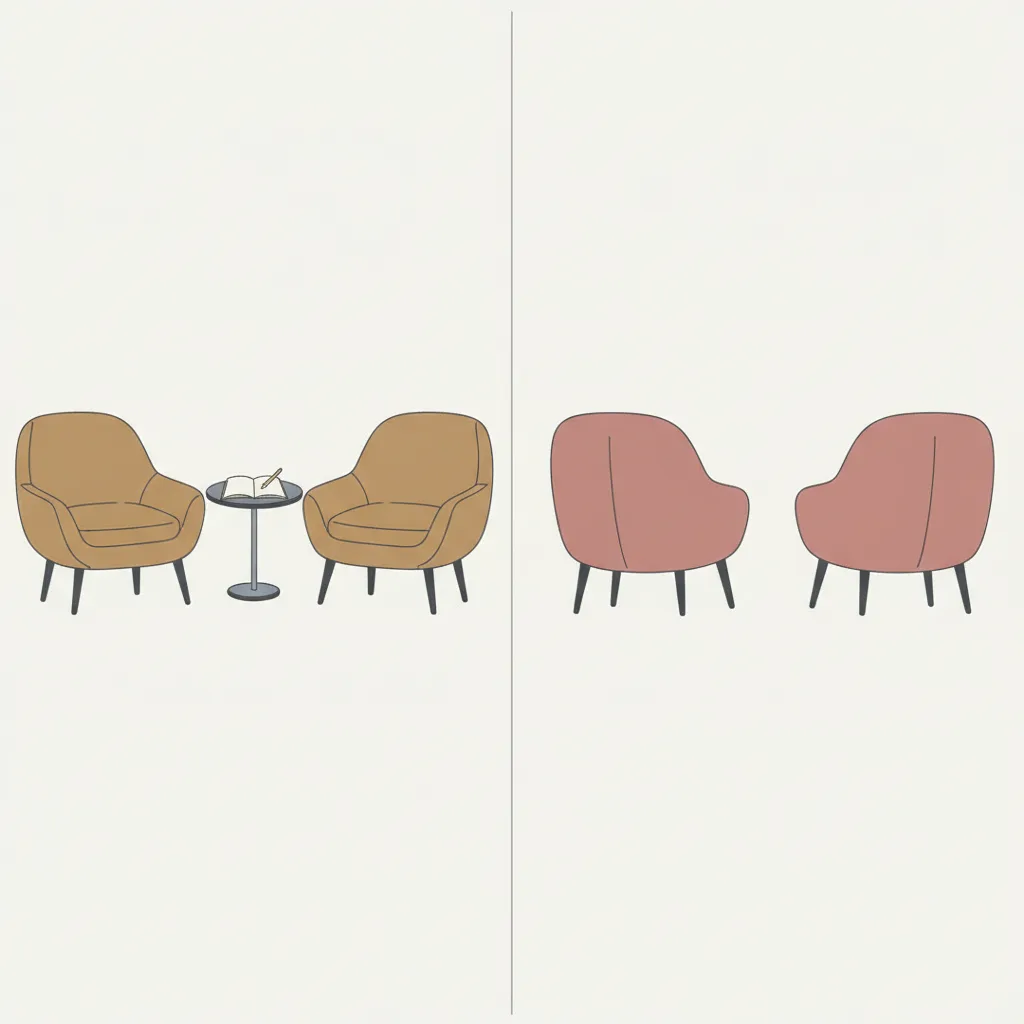


About one-third of unhappily married adults who stayed married were still unhappy five years later (an outcome, not a regret survey), according to Waite et al.’s 2002 NSFH study — a rate nearly identical to the 30% of divorced adults who report regretting their divorce, anchored by Avvo’s 2016 panel survey (27% women, 39% men) and corroborated by broader estimates reaching at least one-third. The gender gap in divorce regret is consistent: men regret divorce more often than women, likely because women initiate roughly two-thirds of divorces and have therefore had more time to process the decision before it becomes final.
The cultural framing heavily favors action: divorce is positioned as liberation, staying as settling. The data complicates this. Waite’s finding that most unhappy marriages self-correct within five years is one of the more robust results in this literature, based on a nationally representative panel (NSFH) that tracked the same unhappily married respondents from a baseline rating to a five-year follow-up. It does not mean staying is always better — the study excluded abusive marriages, and “happy” was measured by a single survey item. But it does mean the widespread assumption that unhappiness in marriage is permanent is empirically wrong for the majority.
The near-parity between divorce-regret and staying-and-staying-unhappy rates (roughly 30% vs one-third) makes this one of the most balanced entries in the dataset — bearing in mind the inaction figure is an outcome, not a self-reported regret. The delta is within the margin of error for both surveys. The practical implication is that neither path reliably avoids regret — which is itself a useful calibration against the certainty that either side’s advocates tend to project.